
SmartAcre’s UNBOUND Day 1 Takeaways

Summarize this insights post with:
If you’re wondering what our SmartAcre group chat is looking like during Day 1 of UNBOUND, picture ten of us scattered across the Boston Convention Center, laptops and phones out, typing in between sessions before we lose our thoughts. There’s always that moment mid-session where you catch someone else on the team locking eyes with you, both of you realizing you just heard something that connects directly to a client you’re already picturing. That’s the feeling driving most of these messages, genuine excitement about getting to bring these ideas home and actually put them to work.
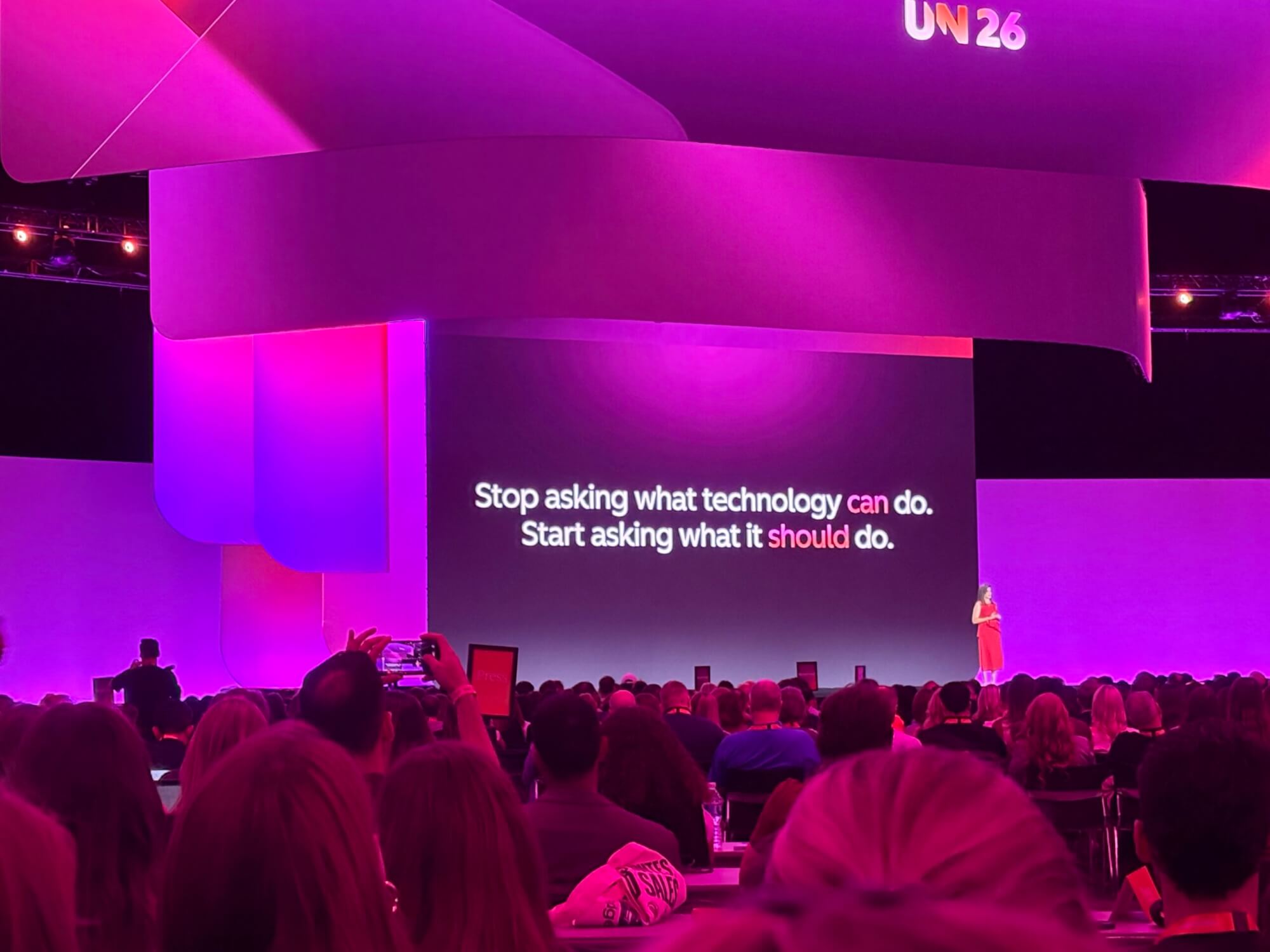
Our team has been posting those reactions in real time on the UNBOUND live take feed all day, and reading back through Day 1, a few ideas kept surfacing in different rooms, from different people, in different words. So instead of a session by session recap, here’s what our team was actually chewing on today, and what it means for the work we do for clients.
Data is easy. Context is the hard part.
Across the CRM and agent sessions today, the word that kept coming up wasn’t data, it was context. Amanda Trevino’s take from the room summed it up well: “In the age of AI, context is king.” Her point was that most CRMs are already good at storing what happened – what they’ve never been good at is capturing why any of it mattered. If AI is going to recommend, prioritize, or act on a company’s behalf, clean data is only step one. It still needs to understand the customer, the business, and what should happen next.
Justin Johnson’s post from earlier in the day made the same point from a more practical angle, pushing teams to get honest about how confident they actually are in the data sitting inside their own HubSpot portal right now, because that confidence level is about to matter a lot more than it used to.
This is the engineer’s instinct kicking in for us. Hearing “AI can update your CRM automatically” isn’t enough. We want to know what it’s actually reading, what happens when that data is wrong, and who’s watching for it. Before we ever talk to a client about turning on an agent, we’re asking whether the system underneath it is trustworthy enough to hand decisions to.
Buyers stopped clicking. They didn’t stop looking.
The second theme nobody could stop talking about: the idea of a buyer Googling something and clicking a blue link is quietly becoming outdated, and a lot of marketing plans haven’t caught up yet.
Delaney pulled the numbers straight from today’s AEO sessions: 68% of Google searches now end without a click, AI Overviews are cutting click through rates by 61%, and organic traffic to company sites is down 27% year over year. Conversations are focused on how AEO, or answer engine optimization, can help brands adapt. That means building content that answers a question directly, covers the different ways people actually phrase that question, and gives an AI model enough context to recognize and cite your brand when it’s putting together an answer.
Across sessions, AEO’s impact on search kept coming up. In one session, a Reddit post from ten years ago came up as a real example, still surfacing in AI search results today. Why? It closely matches how someone actually phrases the question. Another session highlighted that : a large share of buyers already use AI search during evaluation, and those buyers convert at a meaningfully higher rate. A brand that doesn’t show up there isn’t just invisible. It’s invisible at the exact moment a decision gets made. And more than one session pushed back on the idea that content marketing is dying. Blogs and long form content are still getting cited constantly in AI answers. They just have to be specific, well-structured, and built around a real use case instead of a broad keyword.
For us, the real work here isn’t slapping “AEO” onto a proposal. It’s the mechanics underneath it: why specificity beats broad keywords, why schema and up-to-date information change how a page gets cited, and why cleaning up outdated content matters more now than it used to. That’s the kind of detail our team kept posting about live as the sessions happened.
Smarter AI moves beat more tools.
One stat got repeated back and forth in our group chat more than any other today. It came from the keynote: the overwhelming majority of companies are already using AI, but only a small fraction are seeing it actually move revenue. The gap wasn’t about who had access to better tools. It was about focus. The companies seeing results were applying AI to a handful of high value, data rich problems, things like campaign analysis, pipeline prioritization, and customer feedback. They weren’t spreading it across every possible use case at once.
HubSpot’s Marketing Studio update fit the same pattern. It’s framed around giving teams a single AI powered workspace, not another disconnected tool. The newly rebuilt Breeze Assistant got a similar reaction from our team. People were more excited about how it fits alongside the tools they already use than about it being one more thing to log into. Even a moment from the expo floor backed this up. Dharmesh, HubSpot’s cofounder, launched a free AI native CRM built for one specific audience: solopreneurs who just need a simple second brain. Small, sharp, and aimed at one real problem, not trying to be everything.
We hear from clients all the time who feel behind because they haven’t adopted every new AI feature the day it ships. Today was a good reminder that the companies actually pulling ahead aren’t doing more, they’re doing fewer things, chosen deliberately, and doing them well.
Judgment doesn’t get automated.
Not every session today was about pipelines and platforms. One of the ideas that stuck hardest came from a session on communication in the AI age, and the point was simple: when anyone can generate more copy or more concepts in seconds, the scarce resource isn’t content anymore, it’s judgment. Knowing what deserves to exist in the first place, what to cut, and what an audience will actually remember is the harder skill, and the one that doesn’t get automated away.
A separate session made almost the same argument from the decision-making side, pushing teams to build in real validation wherever AI plays a bigger role in decisions, because speed without a way to challenge the output just means moving fast in the wrong direction with more confidence.
And the data backs this up from the customer’s side, too. A large share of consumers say they can spot an AI-generated ad from a mile away, and most still say advertising needs a human touch to land. As Emily Babinchak put it, “don’t settle for just good AI content, especially when your customers can sniff it out from a mile away.” It’s a fitting bookend to a line Brian Mather pulled from the keynote, one that stuck with our team all day: “Yamini Rangan’s reminder that in the age of artificial intelligence, human intelligence has never mattered more.”
AI can help generate content, summarize a call, or draft a campaign in seconds. It cannot decide what the actual insight is, or figure out the one sentence a client’s leadership team needs to hear first. That’s still on us.
What we’re actually bringing home.
Pull these four threads apart and a pattern shows up. Context matters more than data. Buyers are researching in places most marketing plans don’t cover yet. Smarter AI moves beat a pile of half-turned-on tools. And judgment is the thing that doesn’t get replaced. None of that is a trend we can hand a client as a single slide. It’s a set of questions we can actually use with them:
- Is your data good enough to trust an agent with?
- Are you showing up where your buyers are actually asking questions now
- Are you doing a few things well instead of many things poorly
- Is someone on your team still shaping the story instead of just producing more of it?
That’s the whole point of sending ten SmartAcres to Boston: to come back with sharper questions for the work we’re already doing for clients, and a few new ones we hadn’t thought to ask yet.
The Conversation Isn’t Over.
This is Day 1. We’ve still got two more days of sessions, hallway conversations, and probably a few more lines that make our group chat light up. Keep following along with our team’s live takes from the floor as they post, and we’ll be back with what Day 2 and Day 3 add to the pile.