
ChatGPT Ads 101: How B2B Brands Can Prepare for the 2026 Rollout

Summarize this insights post with:
How to Advertise on ChatGPT
January 16, 2026, marked the start of a new advertising era. This is the date OpenAI announced its approach to advertising and expanding access to ChatGPT. While most innovative marketers probably earmarked the idea of LLM advertising in 2026 budgets, this announcement officially sparked excitement around first to market and making this new channel a predictable revenue driver.
Most of us immediately asked, ok, but how? How do I advertise on ChatGPT? The better, and more important question is:
“How do I show up when buyers are actively trying to solve something?”
That distinction matters because ChatGPT ads are not an extension of search advertising. They represent the first real shift in digital advertising since Google introduced keyword-based search in the early 2000s.
We are moving from the Keyword Era to the Intent Era. And that changes everything.
If you wait for the self-service ad manager to open, you’ll already be behind. Admittedly, I’m not an expert in this (yet-to-be-seen) ChatGPT ad platform, but I can provide my best take on strategic recommendations to help you prepare for the rollout of ChatGPT advertising and the continued shift into the intent era.
ChatGPT Ads 101
Here’s what we know so far about ChatGPT ads as of February 2026. OpenAI has moved quickly from speculation to execution in a controlled, managed pilot phase restricted to a small group of beta partners (mostly enterprise brands). There is no public “ChatGPT Ads Manager” yet. Several rules are already clear and unlikely to change.
- Ads are currently being shown to Free and ChatGPT Go users in the U.S., limited to adults.
- Sponsored placements appear at the bottom of answers, clearly labeled, and triggered by the semantic context of the conversation rather than a single keyword.
- Early test partners are seeing CPMs in the $60 range, which signals how OpenAI expects this inventory to be used. This is not a volume channel. It is surgical, high-intent exposure in moments of active problem-solving.
- OpenAI has drawn a hard line between answers and ads. Paid placements do not influence the organic response. They exist as a supplemental recommendation, not a steering mechanism.
You cannot buy authority inside ChatGPT. You can only extend it. If your instinct is to wait until costs come down or self-serve opens globally, you are already behind. By then, the brands that understand conversational relevance will have shaped how their category is framed.
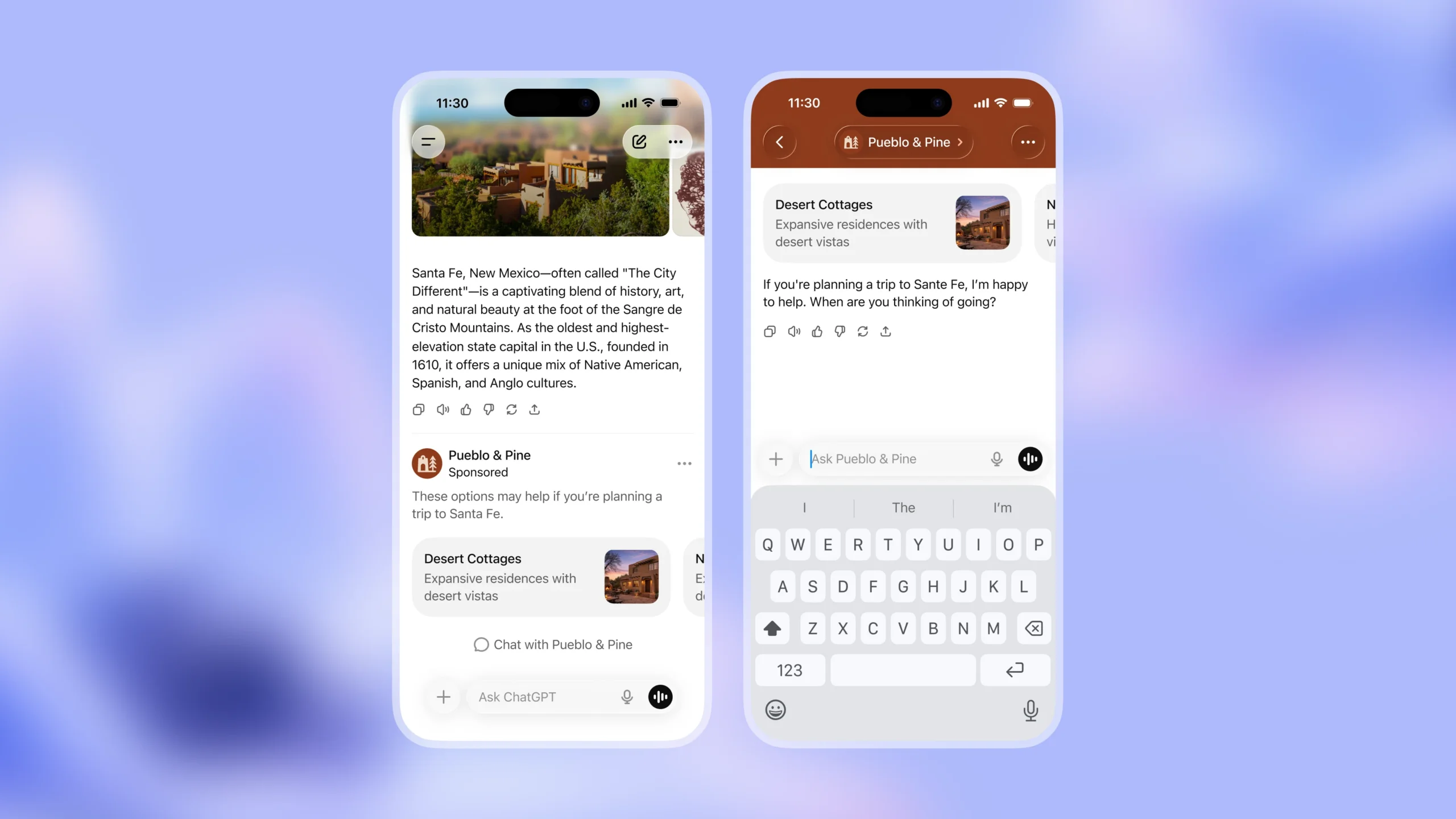
Why this matters: When the self-service platform inevitably opens later this year, the brands that have already mapped their “Prompts” and optimized their technical content will win the initial (and cheapest) auctions.
The Strategic Shift: From Targeting Audiences to Targeting Intent
The most significant change for B2B leaders is not media buying mechanics. It is a mental posture. Traditional B2B advertising starts with audience definition: job title, industry, and company size. ChatGPT advertising starts one step later, when those people are already thinking through a decision.
The right question is “What question does our best buyer ask right before they need us?” That distinction matters because ChatGPT is not a discovery tool. It is a problem-solving tool.
A generic ad that says “We do RevOps” fails because it adds no value to the conversation. An ad that says “Here is the roadmap we use to untangle lifecycle chaos across HubSpot and Salesforce” succeeds because it advances the buyer’s thinking. In this model, the ad is not a pitch. It is the step the assistant would recommend if no ad existed at all. For B2B services, this is an asymmetric advantage. Complex offerings perform best when buyers are already wrestling with trade-offs, risk, and implementation reality. That is precisely the mental state ChatGPT optimizes for. Because ads do not influence answers, the model’s understanding of your brand becomes the ceiling on paid performance. If ChatGPT does not “know” what you do, your sponsored placement has to work uphill against uncertainty.
This is where Generative Engine Optimization becomes table stakes.
At a practical level, this means your content must be structured in a way that mirrors how buyers ask questions. Decision-stage topics, clear definitions, explicit frameworks, and unambiguous proof matter far more than thought leadership fluff. It also means your technical foundation matters again, but differently. Schema markup for services, case studies, and outcomes is no longer just about SEO crawlers. It is about machine comprehension. If your results are not machine-readable, they are invisible.
Finally, every brand should be able to articulate the one sentence they want ChatGPT to say about them. Not a positioning statement. A recommendation. If that sentence is vague, everything downstream will be as well. This is why having a strong point of view and brand differentiation is so important and how businesses of all sizes will be able to stand out.
Message specificity, use-case focus, and customer intimacy are not weaknesses in an answer-driven environment. They are the differentiators. Brands willing to say “we’re not for everyone” often sound more trustworthy than brands that claim to be for everyone. Importantly, this is not about “getting your brand out there.” Most buyers are not looking for more names. They are looking for confirmation that someone understands their situation and can help them avoid a mistake.
If you don’t have these fundamentals down, start here. You need a brand story, deep understanding of your audience, and content and offers mapped to your buyer’s journey. The work required to succeed here, clear differentiation, honest positioning, and use-case specificity, pays dividends far beyond ChatGPT. It strengthens every channel that follows.
If you are ready to take the next steps for a solid ChatGPT ad lunch when the time comes, keep reading.
Phase 1: Establish Organic Authority (GEO)
Because ads do not influence answers (well – Anthropic and Claude do have some strong opinions on this), the model’s organic understanding of your brand is the ceiling for your paid performance. Take these steps now:
-
Action: Audit your technical content. Add question-based headers (H2/H3) to your blog posts (e.g., “How does RevOps actually work in HubSpot?”).
-
Action: Use
Service,CaseStudy, andReviewSchema markup. If your success is not machine-readable, it is invisible to the AI. -
Action: Define your One-Sentence Recommendation. If ChatGPT had to recommend you in one sentence, what should it say?
Phase 2: Map the Intent (The “Prompt Bank”)
Your keyword research documents need more than keywords now. They need questions. Stop just thinking about who to target and start thinking about what they are asking.
-
Action: Identify 20 “High-Intent Conversations.” These are the questions your best buyers ask 30 seconds before they need a vendor.
-
Problem-Stage Examples: “Why is my lead scoring data failing?” or “How to scale demand gen without increasing headcount.”
-
Action: Map each prompt to a specific Proof Point (a framework, a checklist, or a case study).
Bonus: You can start mapping this prompt bank to AEO friendly website content TODAY. For example, start adding FAQs to all pages that mirror this exact format.
Phase 3: Design Creative as a “Conversational Extension”
In an Answer Economy, interruption is friction. Contextual assistance is the new click-through rate. Start thinking of ads in these type of formats.
-
Format: The “Clarifier.” Ads that simplify the complex or correct a common technical misconception. “Most HubSpot migrations fail because of X. Here is the 30-day roadmap to fix it.”
-
Format: The “Pattern Interrupter.” Reframe the problem to offer a more useful mental model. “Stop focusing on MQLs. Here is the framework we use to build pipeline for Manufacturing.”
-
The Rule: If the copy sounds like a brochure, it’s an interruption. If it sounds like a Peer-to-Peer recommendation, it’s an asset.
In my opinion, this isn’t new. It is good marketing. Traditional brand slogans, broad claims, and generic CTAs will underperform. The winning ads will read like expert guidance, not promotion.
Phase 4: Build the “Answer-First” Landing Experience
Click behavior from ChatGPT will not resemble paid social or search. ChatGPT users arrive having just received a direct, structured answer. They will not tolerate being sent to a generic homepage. With HubSpot research noting LLM-driven AI search visitors are 4x more valuable than traditional search clicks, your website experience needs to be ready for this.
-
Action: Create problem-specific landing pages
-
Action: The headline must acknowledge the prompt immediately.
-
Action: Offer a consultative next step (a diagnostic, a template, or a roadmap) rather than a hard “Sales Call.” Fortunately, our team has been doing this for years through tools like interactive calculators and guides. Now they are easier than ever to build, like this example created via Loveable.
Rethinking KPIs with LLMs
If you judge ChatGPT ads by CTR alone, you will underinvest in the channel. The real value shows up downstream, in how conversations change.
Early indicators of success include whether your brand appears alongside high-intent prompts, whether prospects repeat your language during discovery, and whether sales cycles compress because buyers arrive better informed. This is less like optimizing paid social and more like measuring influence. The signal is not volume. It is clarity, momentum, and pipeline acceleration.
Final Thoughts on ChatGPT Ads (right now)
ChatGPT advertising is not about buying attention. It is about earning relevance in decision moments. The brands that win in 2026 will not be the loudest or the most aggressive bidders. They will be the ones who help the AI and the buyer think more clearly.
If you treat this as “another channel,” you will be late. If you treat it as a distribution layer for your point of view, you can shape how your category is understood.
That is the opportunity in front of B2B marketing leaders right now. Just like we’ve effectively married PPC and SEO, it is time to align intent-related search to your future advertising strategy.